By ilovetoeatspicy editorial team · Updated
Card Games for Couples
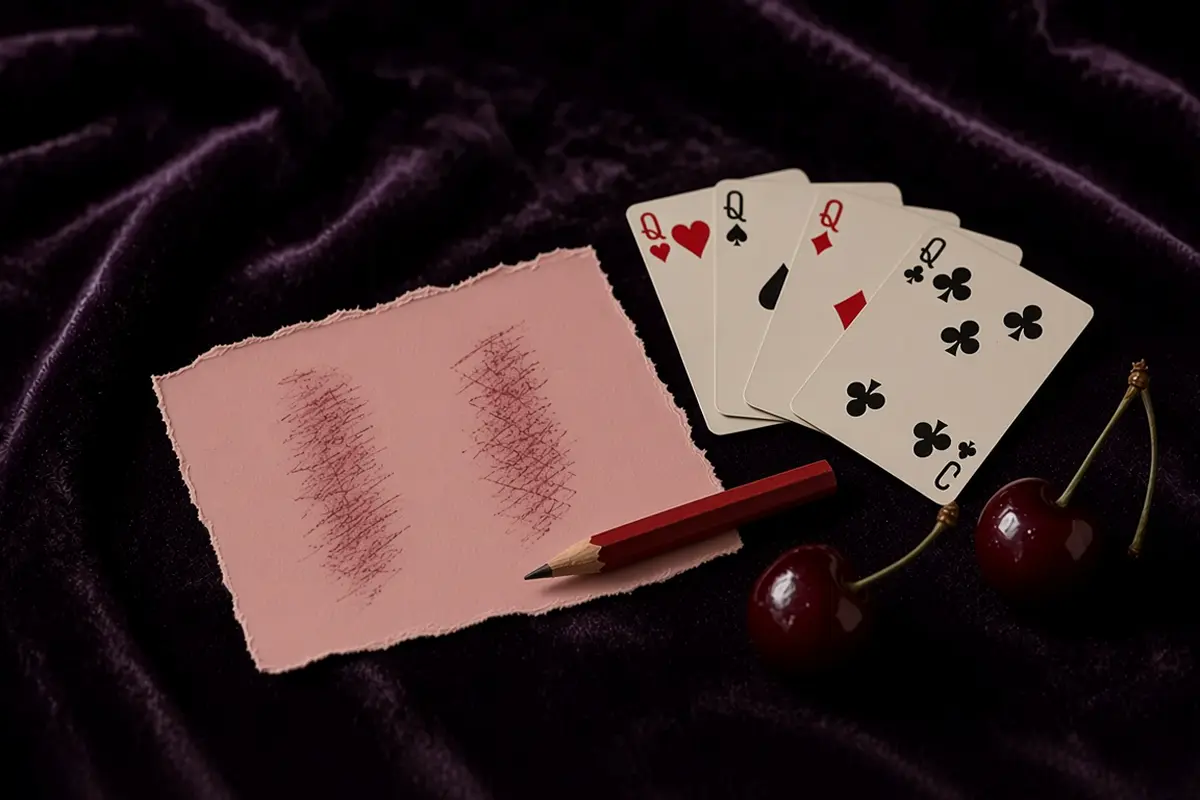
Two people, one ordinary 52-card deck, about 15 to 20 minutes. This page is an editorial house-rule format for a short card session at the table. It is not the official rules of any branded or published card game, not casino play, and not a lesson in gambling.
Leave both jokers in the box. The default session does not use them. You do not need a signup, a specialty deck, or an app. A little table space, one shuffled deck, and an agreed stop time are enough. Scrap paper for scores is optional.
Setup for a 15 to 20 minute session
Plan about 15 to 20 minutes, including the shuffle. That length is our suggestion for tonight, not a measured ideal. Either person can stop sooner.
The deck. One ordinary 52-card deck. Hearts, diamonds, clubs, and spades, with ace through king in each suit. Both jokers stay out. If a joker turns up while you deal, set it aside and deal the next card. Do not give it a value in these games.
The table. Enough space for two small hands, a face-down stock, a face-up discard, and later a grid of 12 cards. A cleared corner is enough. You do not need a special cloth or a score board.
Paper. Optional. If you want a record, draw three lines on scrap paper and two columns, one for each person. The sample pad below shows the shape. A phone note is fine. You can also say the numbers and skip the paper.
Jobs. One person shuffles. The other deals. Swap those jobs at the next game. Agree who plays first before the first card. In the sample, A starts each game. That is a sample choice, not a rule that the same person always starts.
Stop time. Before game 1, name a clock time about 15 to 20 minutes away, or agree to stop after game 2 if energy drops. When that time arrives, finish the turn you are on and stop. A second session needs a new yes from both people.
No account. Nothing on this page asks you to sign up, pay, or install an app. You do not buy a themed deck to use these house rules.
Three house games, in this order
Play these three house games in this order. Each one is about 5 to 8 minutes. Stop after two if energy drops. Do not reorder them in the middle of a session, and do not add a fourth game. The names below are our house rules for folk-style patterns. They are not a rule sheet from a published card game.
Shared values you will need twice. In Six-card Golf, an ace is 1, a king is 0, a jack is 10, and a queen is 10. In an Eights leftover, an ace is 1, and a jack, queen, or king is 10. A king is 0 only in Golf. An ace is high only in the optional game at the end of this section, which the sample does not play. Number cards count as the number printed on them, including 8.
Game 1. Six-card Golf. Deal 6 cards to each person, face down, in two rows of three. Each person may look at any two of their own cards, once, then set them face down again. The rest of the deck is the stock. Turn one card face up beside it. That card is the discard. Suits do not change a Golf value.
On your turn, take the discard or draw one card from the stock. Swap that card with one of your six. The card you remove becomes the new discard, face up. You may use your memory of the two cards you saw. You choose the slot before you turn it up, and the swap stands. A hole ends after each person has taken 3 turns. Both people then turn their grids face up and add the values. The lower total is the better hole. Write both numbers. There is no prize.
A full game 1 is two holes, about 5 to 8 minutes together. If the first hole already feels like enough, skip hole 2. Do not play a third hole. Shuffle before the second hole if you play it. The sample plays one complete hole and skips the second.
Game 2. Eights for two. Shuffle the 52 cards again. Deal 7 cards to each person. Turn the next card that is not an 8 face up. That card starts the discard. If you turn an 8, put it on the bottom of the stock and turn another card. Do not start on an 8.
On your turn, play one card that matches the suit or the rank of the top card. An 8 may be played on anything. Name the suit the next card must follow. Do not name a rank. If you cannot play, draw one card from the stock. If that card fits, you may play it now. If it does not, your turn ends. One draw on a turn, not a string of draws.
The person who empties a hand has the better result for this game. If nobody is out after 6 turns each, or after about 6 minutes, stop and add the cards left in each hand. The lower leftover is the better result. Write both numbers. If you both want to stop earlier, write the leftovers the same way and move on. The sample stops after two turns and does this. Suits matter when you play. They do not change the leftover value.
Game 3. Pair Match. Shuffle again. Lay 12 cards face down in three rows of four. The rest of the deck is a face-down pile. On your turn, turn two cards face up. If they share a rank, you keep them as one pair and your turn ends. You do not take a bonus turn. If they do not match, turn them face down again. Suits do not have to match. Before the next turn, fill any gaps from the top of the pile, lowest numbered gap first, until the grid is full or the pile is empty.
Stop after 4 turns each, or about 6 minutes, whichever comes first. Count pairs. The higher count is the better result. Write both numbers. Do not keep playing until the deck is gone. If the counts match, write the same number and move on. No replay is required. The sample plays two turns and stops while it is still fun.
Stop. Stop when game 3 ends, when the agreed time arrives, or after game 2 if energy drops. Either person may stop earlier, including in the middle of a hand. Finish the turn you are on if a card is already in motion, then stop. Do not add a fourth game, a drink, or a punishment.
Optional replacement, not a fourth game. Before game 3, you may both agree to play Kinder Battle instead of Pair Match. It is our capped house version of the folk pattern sometimes called Battle or War. It is not a published rule sheet. Deal the 52 cards into two face-down piles of 26. Do not look. Each trick, both people turn one card. The higher rank takes both cards and puts them under that person's pile. Ace is high, above the king. Suits do not matter. If the ranks match, each person turns one more card, and the higher of those takes all four. If those also match, set the four aside. The next person to win a trick takes the set-aside cards too. Stop after 10 tricks, or about 6 minutes. Count cards. The higher count is the better result. Stop even if the piles are uneven. Do not continue until one person holds the whole deck. If you use Kinder Battle, do not also play Pair Match. The sample does not use it, so the pad has a Pair Match line and no Battle line.
Fair play for a short session
Either person can skip a game or end the session. Say "Let us skip this game" or "Let us stop." The other person says "All right." You do not owe a reason. A skip is not a low score. If you skip Eights, you may still play Pair Match, or you may stop. Ending in the middle of a hand is allowed.
A spoiled shuffle. If either person thinks the deck was not shuffled, or a card was seen while dealing, put that game's cards back together, shuffle, and deal it again. Do not score the spoiled deal. There is nothing to argue about, and nobody has to prove what they saw.
Honest, light scores. Write the number the cards make. Do not lower a number to be kind, and do not raise one as a joke. A high Golf total is only a high number. Do not tease a missed pair, a full hand, or a face-down card someone forgot. You can laugh together. The laugh is not a prize for the other person.
What a result is not. The better number is not a test of who cares more, and it is not a test of who is smarter. Do not keep a running verdict on the relationship. No alcohol is required. Do not play for money, chips, clothing, or a dare the other person owes. Do not flick cards at each other, grab a hand, or add a physical penalty. Nothing in the session asks anyone to accept a punishment for a bad hole.
A sample stretch of play
This sample uses the default order. Game 1 is one complete hole, then hole 2 is skipped. Game 2 shows two turns, then an agreed early stop with leftovers. Game 3 shows two turns, then a stop while it is still fun. Kinder Battle stays unused. If you use the cards and choices below, you will reach the pad in the next section. A full Eights game can still run to an empty hand or to 6 turns each. A full Pair Match can still run to 4 turns each. This stretch is the short way through one evening.
Golf, the deal. Jokers are out. B shuffles. A deals 6 cards each, face down. A looks once at the top left, the 4 of hearts, and the bottom middle, the 9 of hearts, then sets them down. B looks once at the top middle, the king of spades, and the top right, the 5 of clubs, then sets them down. The grids, which stay hidden during play, are these.
A, top row: 4 of hearts, queen of clubs, 8 of spades. Bottom row: ace of diamonds, 9 of hearts, 2 of spades. B, top row: 6 of diamonds, king of spades, 5 of clubs. Bottom row: jack of hearts, 3 of spades, 10 of diamonds. The discard starts as the 7 of hearts. The top of the stock, in order, is the 3 of hearts, the 4 of clubs, the king of diamonds, the 2 of hearts, the 6 of spades, and the ace of clubs. Later cards are not used in this hole.
Golf, six turns. A does not take the 7. A draws the 3 of hearts and swaps it with the known 9 of hearts. The discard is now the 9 of hearts. B does not take a 9. B draws the 4 of clubs and swaps it with the bottom left, the jack of hearts. The discard is now the jack. A does not take a jack, which counts 10. A draws the king of diamonds and swaps it with the top middle, the queen of clubs. The discard is now the queen. B does not take a queen. B draws the 2 of hearts and swaps it with the bottom right, the 10 of diamonds. The discard is now the 10. A draws the 6 of spades and swaps it with the top right, the 8 of spades. The discard is now the 8 of spades. B leaves that 8, draws the ace of clubs, and swaps it with the top left, the 6 of diamonds. Each person has taken 3 turns, so the hole ends.
Golf, the score. A turns up 4 of hearts, king of diamonds, 6 of spades, ace of diamonds, 3 of hearts, and 2 of spades. That is 4 + 0 + 6 + 1 + 3 + 2 = 16. The king is 0 in this game. B turns up ace of clubs, king of spades, 5 of clubs, 4 of clubs, 3 of spades, and 2 of hearts. That is 1 + 0 + 5 + 4 + 3 + 2 = 15. B has the lower total. They write 16 and 15. Nobody teases the 16. They skip hole 2 so the session can reach the next game. Skipping the second hole is allowed. It is not a spoiled deal.
Eights, one turn each, then a choice. They gather the 52 cards, leave the jokers out, and shuffle again. B deals 7 each. The starter is the 5 of diamonds, so the discard did not start on an 8. A holds the 5 of clubs, 9 of hearts, 2 of spades, king of diamonds, 8 of hearts, 4 of clubs, and jack of spades. B holds the 7 of hearts, queen of hearts, 3 of spades, 6 of diamonds, 10 of diamonds, ace of hearts, and 4 of diamonds. The top of the stock is the 8 of spades.
A plays the 5 of clubs on the 5 of diamonds. The top card is now the 5 of clubs. B has no 5 and no club, so B draws one card, the 8 of spades, and may play it. B plays the 8 and names hearts. If they continued, A could play the 9 of hearts or the 8 of hearts. They do not. Both still want a third game, so they stop Eights here and write leftovers. A has 9 + 2 + 10 + 8 + 4 + 10 = 43. The king counts 10 in an Eights leftover, not 0. B has 7 + 10 + 3 + 6 + 10 + 1 + 4 = 41. B's leftover is lower. They write 43 and 41 and move on. They could have ended the whole session instead. They choose to play game 3.
Pair Match, then stop. They shuffle again. The 12 face-down cards, left to right and top row first, are the 9 of diamonds, king of hearts, 2 of clubs, 9 of spades, 6 of hearts, queen of diamonds, 4 of spades, 7 of clubs, ace of hearts, 3 of diamonds, jack of clubs, and 5 of hearts. The next two cards of the pile are the 2 of diamonds, then the 8 of clubs.
A turns card 1 and card 4: the 9 of diamonds and the 9 of spades. The ranks match, so A keeps one pair. The turn ends with no bonus flip. The empty slots are filled in number order: card 1 becomes the 2 of diamonds, and card 4 becomes the 8 of clubs. B turns card 2 and card 5: the king of hearts and the 6 of hearts. The ranks differ, so B turns them face down again. B keeps no pair. They are still having a good time, so they stop. They do not play the rest of the 4 turns each. They do not switch to Kinder Battle. They do not start a fourth game. A has 1 pair. B has 0. They write those counts, say one thing that was fun, and clear the table.
After the cards, one phone?
The sample above is enough to start, and the score pad is in the next section. When the card session is over, you can switch to the free couples board on one phone. Read truth or dare game for couples online, then play free. The age check stays on the play screen. That board is a separate game. It does not deal these cards, and it has no remote mode.
Play freeA tiny score pad
Before game 1, the paper can be three lines and two columns. After the sample, it reads like this. Golf, hole 1: A 16, B 15. Hole 2: skipped. Eights leftovers: A 43, B 41. Pair Match: A 1, B 0.
Read each line on its own. In Golf and in Eights, the lower number is the better result. In Pair Match, the higher number is the better result. Do not add 16, 43, and 1 into one total. The lines point in different directions. The pad is a record of the evening, not a championship and not a verdict.
If you skip a game, write "skipped" and leave the numbers blank. Do not invent a score for a game you did not play. If you had used Kinder Battle instead of Pair Match, that count would replace the Pair Match line. You would not keep both. The sample did not do that.
Next time, you can play both Golf holes, run Eights to the cap, and give Pair Match the full 4 turns each. Use the same values, the same stop, and a fresh pad. The sample numbers belong to the cards above. A new shuffle will make new numbers.
A video call, and where to go next
A video call can use the same three games, the same order, the same stop, and the same pad. Each person needs their own ordinary 52-card deck. Say the cards out loud, including the two Golf peeks, each draw, and each Pair Match flip. This is an honor system. Nobody can see the other deck. This site does not deal these hands, and it does not open a remote card table.
For other games built for text and calls, see long-distance relationship games. Those are separate activities. They are not a second set of card rules, and they do not turn this page into a shared digital table.
Leave the other guides where they are. Couples games to play at home without props are five games that need no deck. They are framed without cards. This page is the session for when a deck is already in the room. It does not repeat those five. For a short spoken warm-up with no deck, see icebreaker games for new couples. For a question round with a written answer key, see couples trivia night. For a drawing game on paper, see drawing games for couples. For a spoken choice between two options, see would you rather game for couples. More guides in this language are on the articles page.
When the card session is over, you can switch to the free couples truth-or-dare board on one phone. Read truth or dare game for couples online, then play free. The age check stays on the play screen. You pass one phone and pick a card. That board is a different game. It does not deal a 52-card hand, and it has no remote mode.
After the cards, one phone?
After the card session, you can switch to the free couples board on one phone. The age check stays on the play screen. That board is a separate game. It does not deal these cards, and it has no remote mode. Truth or dare game for couples online
Play freeCommon questions
Is one deck enough?
Yes, at one table. Use one ordinary 52-card deck and leave both jokers out. You do not need a second deck beside it, and you do not need a specialty deck.
What about jokers?
Leave them in the box. These three house games do not use a joker. If one appears by mistake, set it aside and deal the next card. Do not treat it as a wild, and do not change the sample scores to make room for it.
Can beginners play?
Yes. Read one game, play it, then read the next. You do not have to memorize all three before you start. The sample hole is enough to see a Golf score, an Eights turn, and a stop.
How long is a session?
About 15 to 20 minutes, including setup. Each game is about 5 to 8 minutes, and you can stop after two if energy drops. That length is our suggestion, not a measured ideal. Either person can stop earlier.
Can we play on a video call if each person has a deck?
Yes, on the honor system only. Each person uses their own 52-card deck and says the cards out loud. This site does not deal the hands, and it has no remote card table. For other call games, see long-distance relationship games.
Can kids join a cleaned-up session?
Yes, if the adults want a quiet card session and the child wants to sit in. Keep the same three games. Do not add dating jokes, drinks, money, or a forfeit. This page is not the phone board. That board keeps its age check on the play screen.
Do we need a cribbage board or a second deck?
No. Scrap paper is optional, and a cribbage board is not used. One deck is enough at the table. A video call uses one deck in each place, which is not a second deck on the same table.